Zrenjanin is back on the Milky Way
05/05/2020
Interview with Bojana Matić
16/12/2020Borrego Springs, California
Astronomer Neil deGrasse Tyson said that the atoms of our bodies can be traced to stars that produced them in their nucleuses and then exploded across our galaxy, billions of years ago. He states that this is the reason for our biological connection with all other living beings that exist in the world. Our existence is unique and inseparable from the planet Earth, but also from the Universe.
"We are not figuratively, but literally star dust."
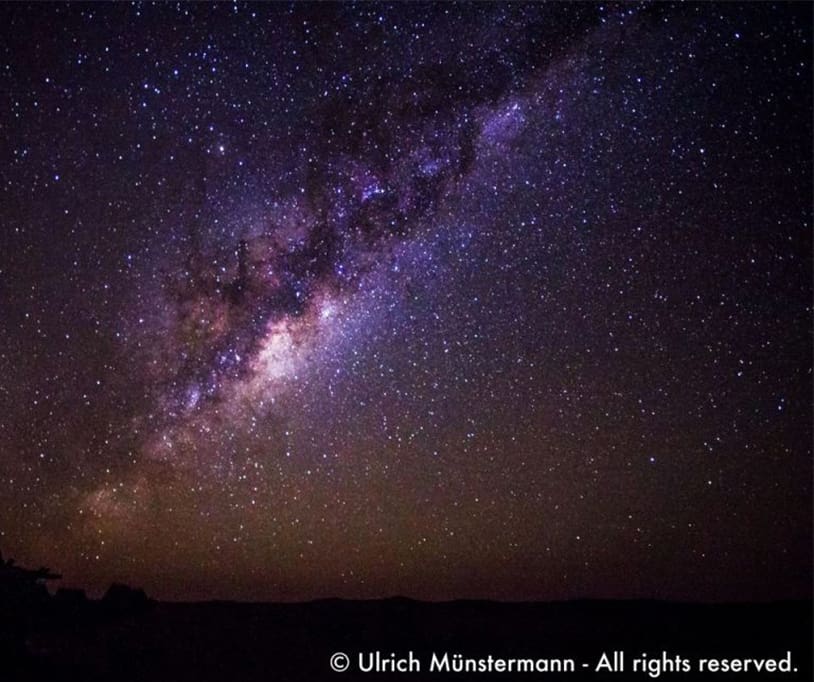
A place in the desert with an incredible view of the silvery celestial river known as the Milky Way, surrounded by starry skies rich in constellations and planets, is located in the United States of America, in California.
Borrego Springs is located in San Diego County, just a few hours drive from city of Los Angeles. It is surrounded by the Anza-Borrego Desert State Park, named after the 18th-century Spanish explorer Juan Bautista de Anza and the Spanish word Borrego, for the species of sheep that inhabits the area.

Borrego Springs has been designated the first International Dark Sky Community in California, and only the second in the world by the International Dark-Sky Association (IDA).
How did Borrego Springs became second International Dark Sky Community in the world?
According to the IDA definition an IDA International Dark Sky Community is a town, city, municipality or other legally organized community that has shown exceptional dedication to the preservation of the night sky through the implementation and enforcement of a quality outdoor lighting ordinance, dark sky education and citizen support of dark skies. Dark Sky Communities excel in their efforts to promote responsible lighting and dark sky stewardship, and set good examples for surrounding communities.
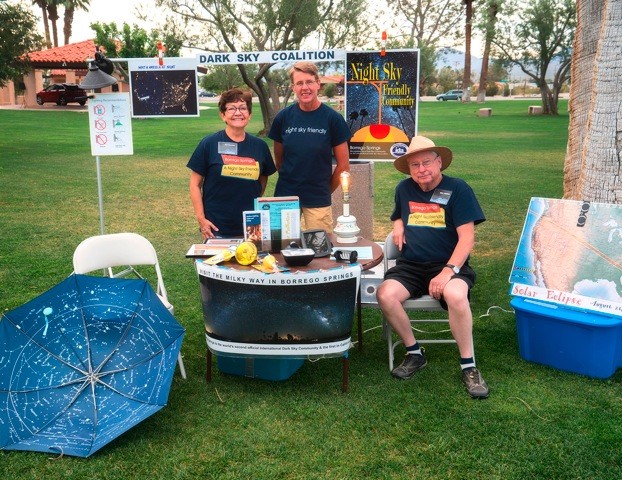
Prior to the official application for the proclamation of Borrego Springs as the International Dark Sky Community, a group of citizens met regularly for two years. The first application was filed on May 14, 2008. However, the existence of a dark sky and awareness of the need to preserve it was not enough at that time. Therefore, the application was rejected, but the Borrego Springs Dark Sky Coalition continued its work.
They re-filed the application in January 2009 in which they provided answers to IDA’s concerns that caused rejection of previous application. Additional efforts were successful, and Borrego Springs was awarded with the designation of International Dark Sky Community as a part of The International Dark Sky Places Program, and on the left you can see a photo of few community members!
- Respecting and sharing the common view that the night sky is a treasure worth promoting and protecting.
- Incorporating the concept of the night sky as a community resource into the community management legal document.
- Creating an active educational program on the importance of the night sky for residents and visitors.
- Alignment of a minimum of 67% of existing lighting with the guidelines with the obligation to reach a level of compliance of 100% in the coming period.
- Creating comprehensive guidelines for outdoor lighting whose main focus is lighting devices.
- Taking a leading role in preventing light pollution.
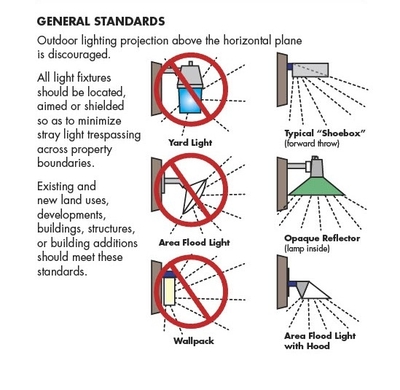
Figure shows examples of good and bad practices when it comes to lighting fixtures.
Regarding the prevention of light pollution, guidelines for outdoor lighting adressed to the residents and local companies of Borrego Springs are especially important. Namely, it is recommended:
- Usage of lighting that minimizes sky glow, glare and trespass.
- usage of appropraite light levels because "more light" is not always the best solution.
- Usage of timers and motion sensors to ensure that the lights are ON when needed and OFF when not needed.
- Evaluate existing lighting. This can be done by observing the lighting of the object from a certain distance, for example across the street. It is necessary to consider the construction of lighting and the way it illuminates the space. If it is not adequate, one should try to adjust the angle or place of attachment of the bulb, or consider upgrading it.
- Usage of fully shielded lamps with bulbs below 4,500 lumens, although the use of fully shaded low-pressure sodium lamps above 4,500 lumens is also acceptable.
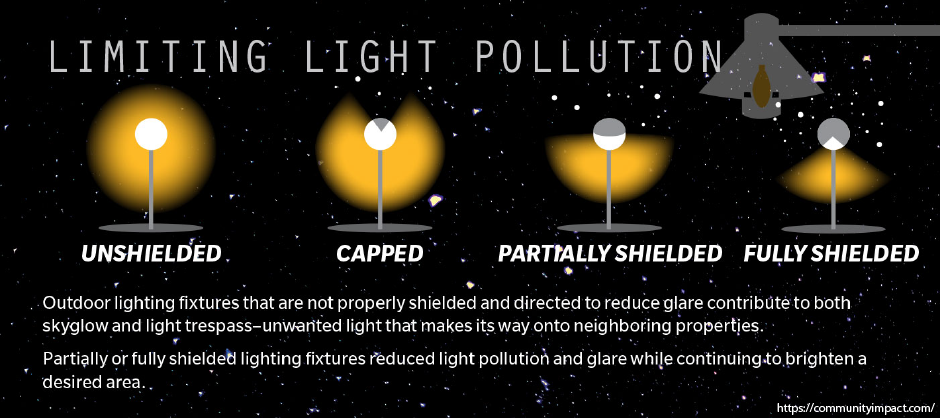
These guidelines are in fact universally applicable in order to establish adequate artificial lighting and preserve the dark sky. According to the calculations of the International Energy Association, the costs of light pollution in America amount to almost ten billion dollars a year. In addition to economic savings, the goal of these standards is to reduce the degradation of the night visual environment, while maintaining the protection and safety that lighting provides.
Another example of good practice from the Borrego Springs Dark Sky Coalition is the awarding of the Night Sky Friendly Business certificate. The certificate is awarded to companies and organizations that follow the guidelines for appropriate outdoor lighting that contribute to the preservation of the night sky.

Picture shows reconstruction of the street lighting in 2008.
Activities in Borrego Springs, California
According to the International Dark-Sky Association, 80% of the population of the Western world has never seen the Milky Way. The reasons for this are numerous, such as lighting from street lamps, billboards and cars. Both large cities and smaller towns are faced with light pollution as a growing environmental problem.
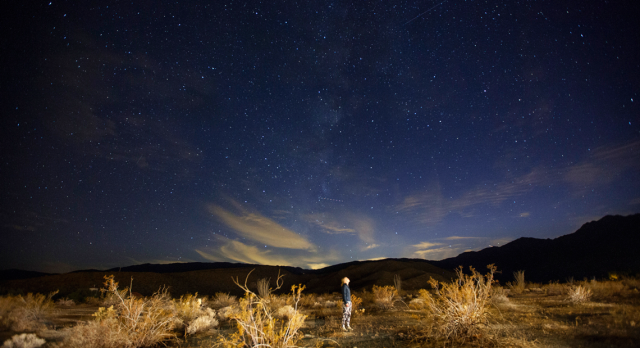
Due to its specific geographical position, Borrego Springs is an ideal haven for amateur and professional star lovers. The conditions for observing the night sky are perfect with more than 300 clear nights a year. The 3,000-meter-high mountains that surround this desert settlement help block light pollution coming from neighboring big cities. They also retain precipitation, which is why the weather is warm and sunny all year round.
The biggest event in the city is the Borrego Springs Dark Sky Weekend which takes place on February 1st and 2nd. Numerous activities are organized, such as guided night walks, observations of various celestial bodies with the help of telescopes and expert lectures on a wide range of "celestial" topics. Throughout the year, in Borrego Springs, you can participate in night sky photography workshops, be a part of an unforgettable meteor shower experience or go camping.
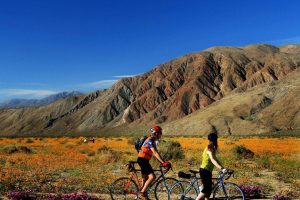
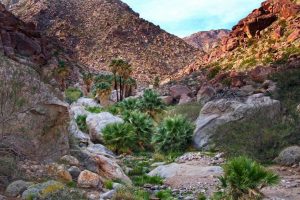
In addition to these activities, you can rent a bike and enjoy a ride through the unique desert landscape or go hiking through Borrego Palm Canyon. You can also learn to play golf on one of as many as four courses in Borrego Springs. The reason why many visitors choose to visit Borrego Springs in the spring is the sight of desert wildflowers and cacti blooming.
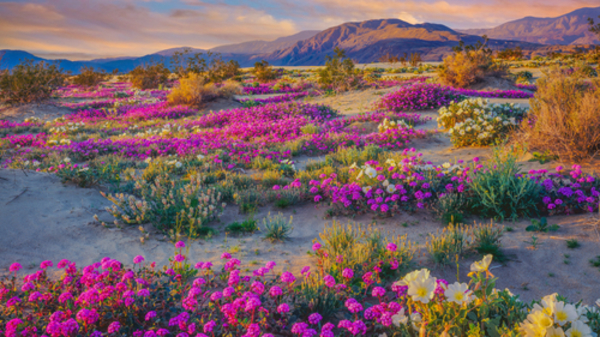
While animals whose habitat is near cities or illuminated areas are finding it increasingly difficult to distinguish day from night. Many animals in the desert environment of Borrego Springs depend on darkness. The vegetation consists mainly of sand and cacti, and during hot days mice and other smaller animals hide underground. When night falls and it gets cold, these animals go hunting. Since they are eaten by coyotes that are also awake at night, the darkness of the night for small animals plays an important role in protection.
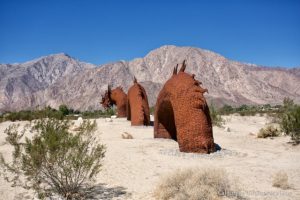
Apart from the desert landscape and the magnificent view of the dark night sky, mountain elevations and diverse flora and fauna, there is something else that makes Borrego Springs and Anza-Borrego authentic. These are large metal sculptures by Ricardo Breceda that adorn this desert area.
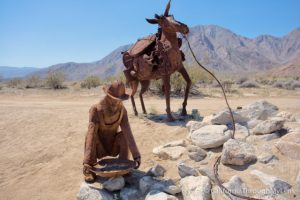
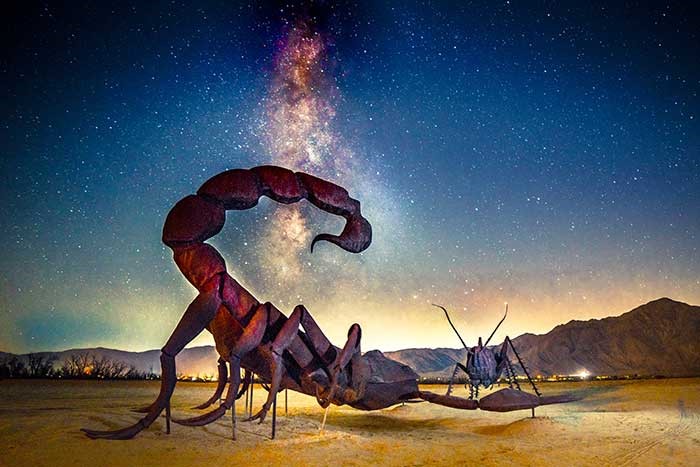
Interview with the members of Borrego-Springs Dark Sky Community
What is the most important lesson that night sky and nature has taught you during these 10 years that Borrego Springs is an International Dark Sky Community?
Ahhh. Easy question. The answer is …. Patience and the importance of Outreach! Having past our 11th anniversary in 2020 as an IDA Dark Sky Community, we can look back to evaluate. We see the mix of early choices, followed by some years of gradual development. We see that numerous frustrations have evaporated, and many of our early plantings have blossomed.
For instance, early on, we asked the county for street signs acknowledging our dark sky status. We made the same request seven years later, and they agreed. Why? Because they came to better understand the issues surrounding outdoor lighting, the economic benefits of night sky tourism, the conservation issues, understood more about the wasted energy and money of light pollution, and the tourist and economic significance of our IDA community designation to the county.
By 2020, we asked for the county codes to be updated and made more restrictive for our area, and by now, there was little to no opposition by the public or our government officials to the code updates. We’ve come a long way promoting an understanding of the issues and the relatively easy steps that can be taken to protect the dark sky, not only without harm to business or the economy, but instead with a positive effect to the economics of the community, as well as contributing to the pride and desirability of the community. In recent years, we hear more and more about people deciding to move here because of the dark sky protection.
Outreach includes stargazing, writing and publishing about dark skies and light pollution, weekly tables at the local Farmer’s Market to talk to people individually and show samples of good light fixtures and help solve lighting problems, regular meetings of our Dark Sky Coalition to plan events and articles, connections made with local government officials, school programs, mailings, a good-lighting recognition program for our businesses, lighting audits free of charge to homeowner associations, interpretive programs about astronomy and dark sky photography, links to observatories, helping other communities with their lighting issues, and other educational opportunities taken to participate in community events.
Close behind Patience comes Perseverance! This is what is needed in the neighborhoods. Lots of it, since there is much misconception about the relationship of porch lighting and safety. But patience does not mean waiting for something to happen. So we are taking an inventory of over-lit residences. We will provide them with lighting information to encourage them to adjust their fixtures.
What is your experience with the topic of light pollution when it comes to collaboration with local authorities, businesses, and the community?
Palomar Observatory is located in San Diego County. Staff is very aware of the importance of minimal lumens. In fact, that was one of the reasons that Borrego Springs qualified as a dark sky community by IDA 11 years ago.
Over the years, we have had good with relations with San Diego County planning. In fact, just this year the San Diego County Supervisors passed a new lighting ordinance, using standards from the IDA. This update of the codes is something our Borrego Springs Dark Sky Coalition was behind as one of main promoters to see it through.
Our unincorporated town is small with fewer than 3,000 inhabitants. Many residents are “snow birds” who have a summer home in the north, and return yearly during the winter. We also have a good number of people of Mexican heritage. Last year we sent a postcard about our work to all residents in both English and Spanish.
We have a good relationship with both residents and business. Most people are enthusiastic about lowering night time lighting. We set up a display at the weekly Farmer's Market where we interact with the public. It is our main contact with the community, and serves as a conduit for comments and complaints.
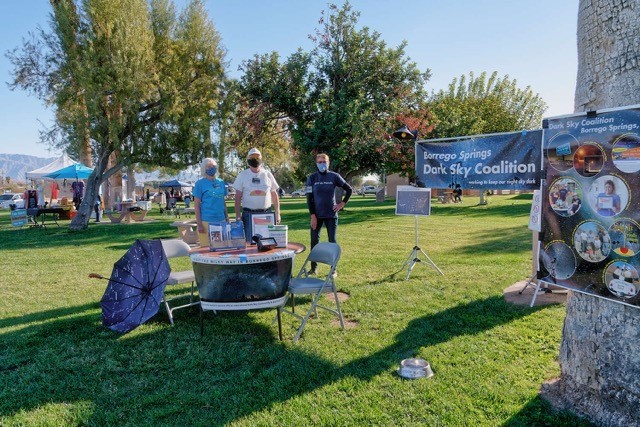
Members of Borrego-Springs Dark Sky Community don't give up promoting dark skies and spreading awareness about light pollution, even during the COVID-19 pandemic. Just one more example of perseverance and adaptation!
Can you tell us more about the benefits of sustainable local socio-economic development through astrotourism?
Our IDA Dark Sky Community status is a benefit to the economy of our town. It is a “Chamber of Commerce” benefit! After the Covid-19 crisis is over, members of the dark sky group will again offer free stargazing programs on a monthly basis. Our town is within a two-hour drive of millions of people in Southern California, most of whom cannot see the major constellations from their home. Many parents bring their families her to see the stars and the Milky Way. This creates an add-on effect to the local tourist economy.
We are surrounded by the largest state park in the lower United States, so instead of coming only for the day, visitors stay for the nighttime attractions of the stars as well. In addition, people come from far and wide, including internationally, because of our IDA Dark Sky status.
Our small town is sometimes included in articles appearing in newspapers and online about “the 10 best places to see the stars” and that sort of publicity. The IDA Dark Sky Community status adds a sense of pride to residents and to our government officials as well…it is a designation we want to protect and maintain. Hence, the recent unanimous vote by the San Diego County Supervisors to update the lighting code for our area in consultation with the IDA.
Secondarily, the IDA designation brings more people to our desert community, where they can experience the desert firsthand, and come to understand its richness in flora, fauna, and its ecology, thereby helping to protect the desert habitat and resources.
If you look a little deeper into the ways of nature's existence, you will understand life more clearly. When was the last time you observed the infinite expanse of stars in the dark night sky? It teaches those who stop and look up to see the bigger picture and broaden their horizons. While the stars will show you that all you have to do is be a shining example of what you want more in the world. Although one star is incredibly significant, what makes the night sky magnificent is when each of these stars shine with its full brightness. Just like the people of Borrego Springs did to preserve the darkness of the night sky.
Until the next Dark Sky Place,
Stay Tuned! The Force Is With Us!
Author
Biljana Bokić
A final year student of Internal Affairs studies at the Faculty of Law in Novi Sad. After participating in The Environmental Protection Clinic, her main areas of interest become environmental law and public health. By writing she strives to contribute to the education on these topics and inspire others to adopt a sustainable lifestyle. Amplitude Magazine columnist. She gets fulfilled by spending time in nature, poetry and interior design. For more blog posts click here.