Eifel National Park – Dark Sky Park
22/02/2021
!Ae!Hai Kalahari Heritage Park – Dark Sky Sanctuary
29/05/2021Mont-Mégantic, Canada
“Dwell on the beauty of life. Watch the stars, and see yourself running with them.”
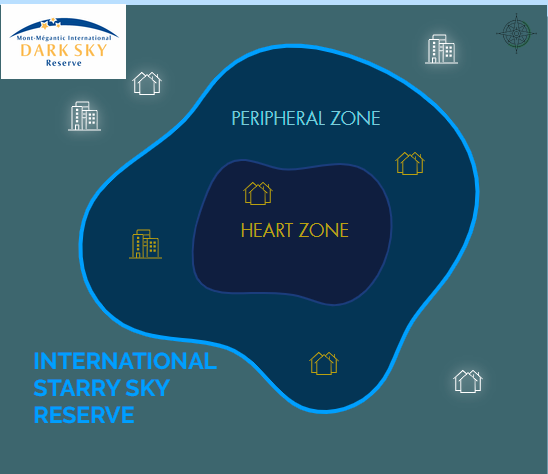
Located in Canada in southern Quebec, Mont-Mégantic is the largest of the IDA International Dark Sky Reserves. Reserve is a part of the Mont-Mégantic National Park but also overspreads in a radius of nearly 50 km around Mont Mégantic, in order to include the main sources of light pollution in those areas. In total, it covers an area of around 5,300 square km which consists of 34 cities and villages that inhabit approximately 225,000 citizens.

In 2007, the region surrounding Mont-Mégantic has been declared the first International Dark Sky Reserve in the world by the International Dark-Sky Association (IDA).
This area is also certified by the Royal Astronomical Society of Canada. The main aim of Mont-Mégantic International Dark Sky Reserve is to conserve starry dark sky, as well as nocturnal environments.
Historical Review of the Light Pollution at Mont-Mégantic
1978
1998
2002
2005
2007
How did the team in the Mont-Mégantic solve the problem of light pollution?
One of the results of becoming an International Dark Sky Reserve is the development of regional expertise in outdoor lighting management. As a consequence of the conversion of thousands of luminaires, light pollution in the heart of the Reserve has been reduced by more than a third, while saving the region nearly 2-gigawatt hours of electricity per year.
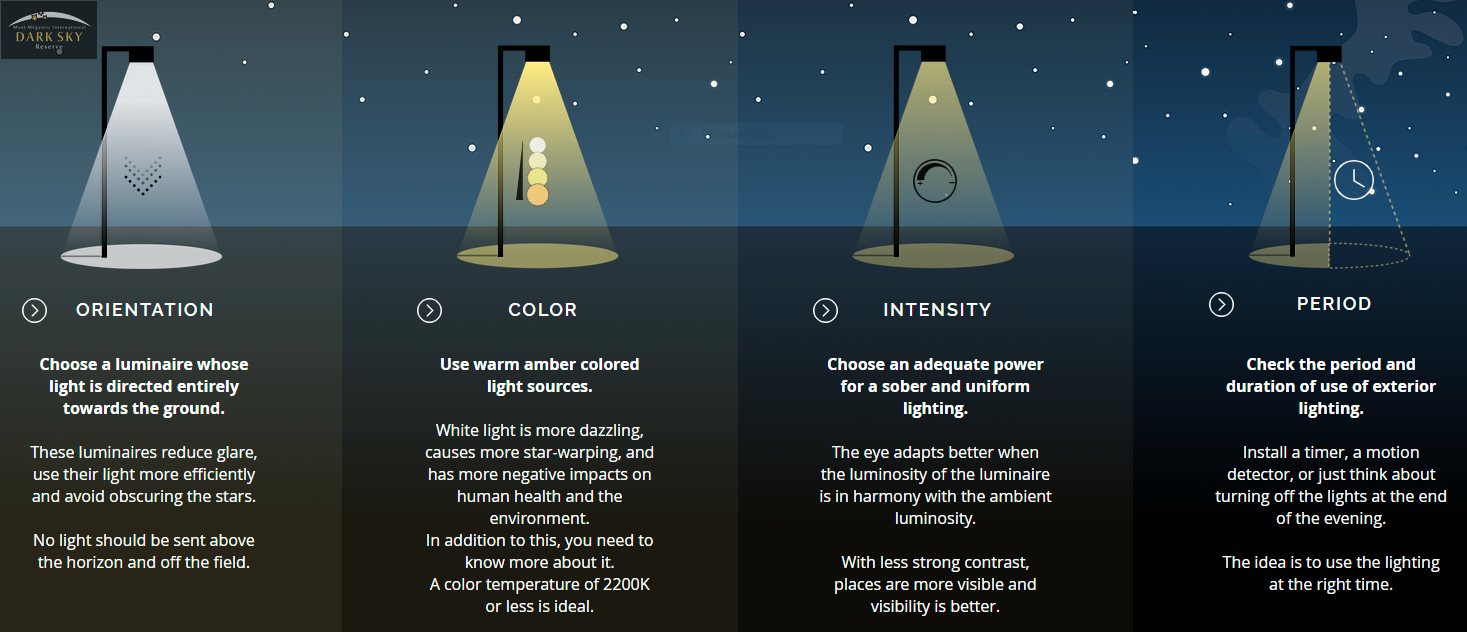
The team of the Mont-Mégantic recommends four intelligent principles in order to provide good lighting everywhere:
- orientation,
- color,
- intensity, and
- period.
In the Mont-Mégantic Dark Sky Reserve municipalities have one of the most important roles in the protection of the dark sky and nocturnal ecosystems.
They are responsible for the management of public lighting and the application of the regulation on the control of exterior lighting. These regulations are conducted by the city of Sherbrooke, Haut-Saint-François, and Granit municipality.
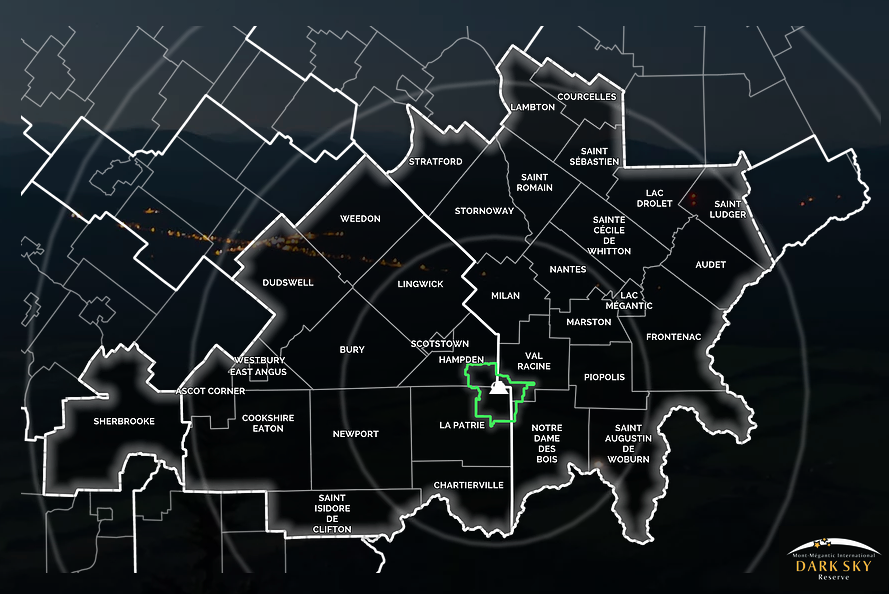
A few of the regulations are:
- LIGHT FLOW ORIENTATION
- Emit less than 1% of the luminous flux above the horizon, or less than 2.5% of the luminous flux if the luminaire is installed at a height less than 7m in Sherbrooke, 5m in zone 2 of the Haut-Saint-François and Granit RCMs, 3.5m in zone 1 of the Haut-Saint-François and Granit.
- COLOR AND LIGHT SPECTRUM
- Light sources of 2200 K and less (10% blue light and less) are permitted for all outdoor uses. The commercial display of areas may use light sources with a maximum color temperature of 3000 K (or 22% blue light). Light sources with a maximum color temperature of 4000 K (or 30% blue light) may only be used for the purposes like the lightning of petrol pumps and sports terrains.
- LIGHT INTENSITY AND QUANTITY
- The installation of exterior lighting devices must correspond to a specific use, or an equivalent task, and must comply with the lighting levels prescribed in the regulations. These maximum lighting levels may vary depending on the type of use in order to ensure the necessary visibility for the specific task. For example, levels for street lighting, commercial display areas, storage areas, and parking lots.
- PERIOD AND HOURS OF OPERATION
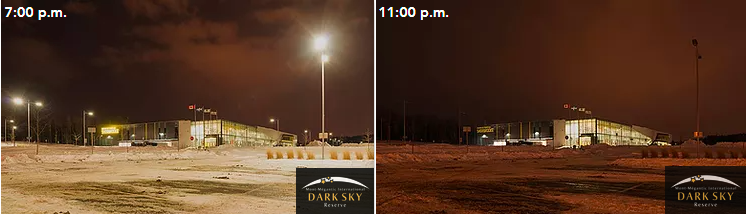
- In municipalities of Haut-Saint-François and Granit, lights are off, including signs, after 10 p.m. or outside of operating hours. Outside of operating hours, exterior lighting in commercial display areas, for example, must be reduced by at least 75%. In the city of Sherbrooke, termination or reduction of lighting is at least 50% after 11 p.m.
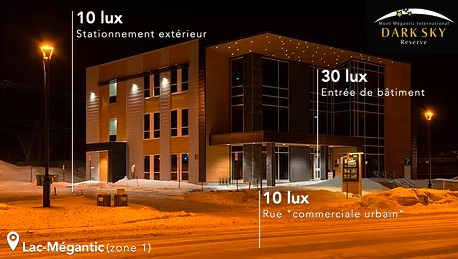
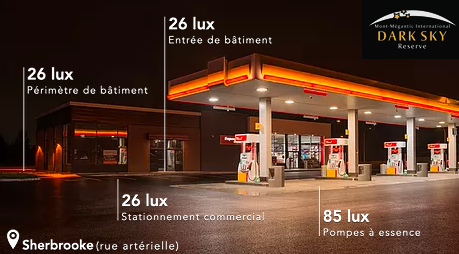
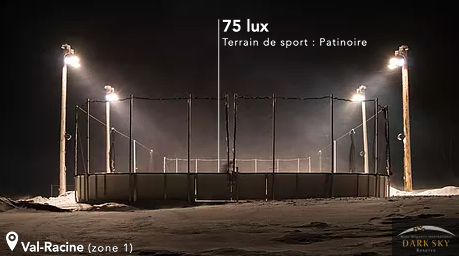
Projects at the Mont-Mégantic International Dark Sky Reserve
The actions and decisions of the Mont-Mégantic Dark Sky Reserve are based on the results of numerous scientific research that have studied the effects of light pollution. You can find a list of scientific articles covering different aspects of nighttime artificial light and its consequences here.
In order to raise awareness among the population of the importance of preservation of the dark sky and its environment, as well as monitor the quality of the sky and promote the use of good lighting, the team at the Mont-Mégantic is always inventing various creative solutions.
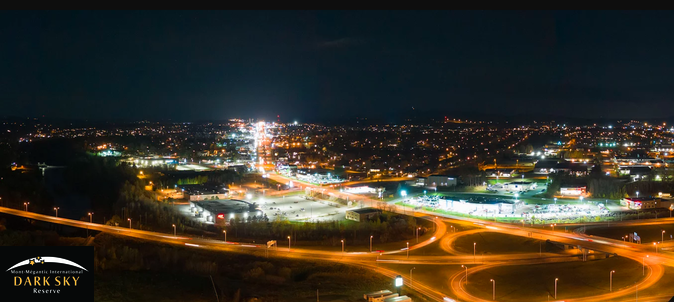
One of those solutions is the pilot project "Starry Sky Objective" which is the result of collaboration with the city of Sherbrooke and its Commerce, whose goal is to make Boulevard Bourque the first commercial artery in Quebec that combines the needs of businesses and the preservation of the starry sky.
The pilot project consists of personalized support at no cost to companies and which includes:
- an eco-lighting consultation service,
- an inventory of the company's exterior lighting,
- a diagnosis of the conformity of the lighting according to the regulations in force,
- scenarios for replacing problematic lighting,
- showcasing the participating companies.
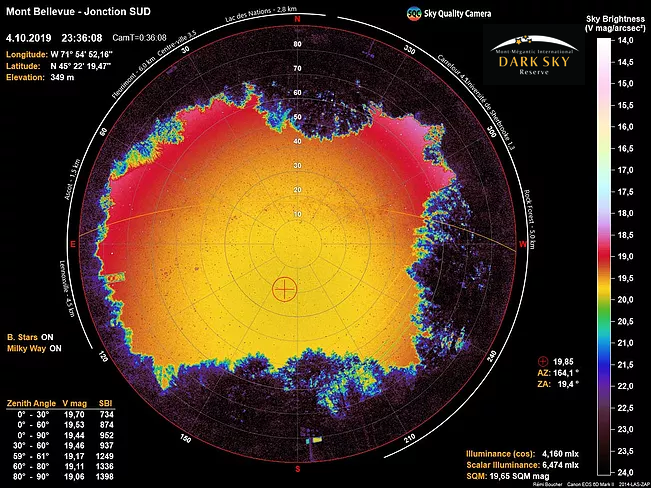
Another project has the aim to restore the visibility of the starry sky within the city of Sherbrooke and allow its citizens to see the Milky Way by creating an urban oasis of starry skies at Mont Bellevue nature reserve. This project is lead by Johanne Roby and Martin Aubé, professors at CÉGEP de Sherbrooke, as well as their team of passionate students.
Activities in the Mont-Mégantic
Public astronomical activities in the Reserve are organized by the National park of Mont-Mégantic. One of the interesting places to visit is the ASTROLab, an astronomical activity center, equipped with exhibition rooms, an ultra-high-definition multimedia room, and numerous telescopes.
Something you can’t miss while in the Reserve is the Mont-Mégantic Observatory. During the day, you can participate in guided tours to see the research telescope and find out all the details of the scientists' methods and operations.
At nightfall, the Mont-Mégantic Observatory is reserved for researchers. For the public, exploration of the starry sky can be done at the ASTROLab and at the Popular Observatory, a second observatory located at the top of the mountain.
Only for a few nights each summer, the Mont-Mégantic Observatory opens its doors to the public for the Mont-Mégantic Popular Astronomy Festival. This tradition is initiated by Bernard Malenfant, then technician at the Observatory and founding president of the ASTROLab.
It offers the unique experience for visitors to observe starry dark sky directly, through the eyepiece of the 1.6-meter telescope of the Mont-Mégantic Observatory, as well as the 61 cm telescope of the Popular Observatory of Mont-Mégantic.
The National park of Mont-Mégantic also organizes special events for the observation of the Perseids' meteor shower in August, which take place at the ASTROLab and at the Popular Observatory.

In 2020, there has been a change in activities happening at Mont-Mégantic. Due to the social distancing measures in place, people were invited to visit the exhibition room of the ASTROLab and watch the movie projection.
During this time, a team of the Reserve held online live astronomy presentations and Q&A sessions on their Facebook page. The themes of the presentations ranged from the bodies of the Solar system to how to measure light pollution at home, black holes, astronauts in space, and the northern lights.
Especially interesting was the live observation with one of the telescopes equipped with a very sensitive camera. Galaxies could appear on the screen in only 5 seconds and you could see the rings of Saturn.
The feedback that the team of the Mont-Mégantic received was fantastic. With a total of 95 live streaming sessions on Facebook, they got a "reach" of more than 2 million people, and more than 70 000 interactions.

The two giants bronze sculptures, called "La Porte des étoiles" (or "stargate" in english) representing the Mont-Mégantic International Dark Sky Reserve with artist Matthieu Binette and Marie-Georges Bélanger from the IDSR.
Local artist Matthieu Binette was commissioned to create two sculptures that would represent the Mont-Mégantic International Dark Sky Reserve on the roads leading to the heart of the reserve.
Installed last year at the center of two busy roundabouts, one in Sherbrooke and one in Lac-Mégantic, the sculptures are made of bronze, granite, and aluminum.
They are a beautiful reminder of places in the vast space beyond our imagination, that we feel deeply connected to, and night starry sky is our only tie to them. "La Porte des étoiles" (eng. stargate) represent timeless values that our generation should pass on to younger ones to cherish.
Interview with the team of the Mont-Mégantic
What would you say are some of the biggest challenges you overcame in order to gain the designation of Mont-Mégantic as the first International Dark Sky Reserve in the world? And what are the challenges that you face today?
The project began long before the certification assessment in 2007. It was necessary to raise awareness among the population about this issue, to build dark sky regulations, and to replace thousands of bad outdoor fixtures installed in cities around Mont Mégantic Observatory.
All of these efforts took time and coordination. We have also put in place protocols and instruments to measure the evolution of light pollution in this area.
Mont-Mégantic International Dark Sky Reserve (MMIDSR) is still the largest reserve with 5,300 km2 and 34 cities involved. Several challenges still lie in outreach, and updating regulations as new lighting technologies enter the market and converting problematic luminaires.
A project like this doesn’t live and evolve over time on its own. Fortunately, MMIDSR receives great support from politicians and other important partners. This project generates great pride and a unique character for the region.
How did the designation of International Dark Sky Reserve contribute to scientific research and the asto-tourism at Mont-Mégantic?
By obtaining the International Dark Sky Reserve certification, the entire region was able to undertake concrete actions to reduce light pollution around Mont Mégantic Observatory and thus ensure the sustainability of research activities.
It is a window to the stars that we wanted to protect to enable researchers to study celestial objects.
However, we shall not forget all the other positive impacts on the region. For example, we decided to protect the nocturnal environment, increased the quality of life of the citizens, contributed to the conservation of ecosystems, and the reduction of energy waste.
A large proportion of tourists who visit the Mont Mégantic region live in big cities and come to enjoy the thousands of stars that can be observed here. The designation guarantees a high-quality night sky and tourists come to enjoy it, throughout the vast territory of the Reserve. So far, several accommodations have adopted dark sky marketing in order to promote this region’s identity.
Is there a project of whose accomplishment you are particularly proud of during these almost 14 years of Mont-Mégantic being an International Dark Sky Reserve?
We are particularly proud to see that there are still so many people on the territory who believe deeply in the benefits of the project and as many politicians who affirm their desire to perpetuate the Reserve.
We are also particularly proud to have opted from the start of the project in 2007 for stricter standards for the correlated color and temperature of the lights. Thus, the color temperature of 2200K and below is accepted everywhere and 3000K is accepted only for certain specific uses. This way, the emission of blue light is minimized.
Over the years, we have also improved our equipment to measure light pollution. Thus, we were able to measure a level of light pollution that remained stable between 2007 and 2017, despite a 12% increase in population on this territory.What activity is a must to experience when visiting Mont-Mégantic?
Mont-Mégantic National Park is located in the heart of Mont-Mégantic International Dark Sky Reserve and its slogan, "from the Earth to the sky", describes very well its identity and the best way to visit it.
During the day, a hike on the mountain is a must to enjoy its breathtaking views and its trails that crisscross valleys and rocky ridges. In the evening, stay in the park to enjoy an astronomical activity led by enthusiasts of the starry sky, who will explain how to observe, with the naked eye and through telescopes, the beauties of the celestial vault.
Two sites are dedicated to this, one at the base of the mountain and the other at the top. Rain or shine, visitors return home in awe!
Sylvia Platt wrote that the feeling of happiness is awakened by the landscape of mountains, trees, fresh air, and people. Thanks to the people of this area who take good care of it, Mont-Mégantic is an inexhaustible source of happiness.
Until the next Dark Sky Place,
Stay Tuned! The Force Is With Us!
Author
Biljana Bokić
A final year student of Internal Affairs studies at the Faculty of Law in Novi Sad. After participating in The Environmental Protection Clinic, her main areas of interest become environmental law and public health. By writing she strives to contribute to the education on these topics and inspire others to adopt a sustainable lifestyle. Amplitude Magazine columnist. She gets fulfilled by spending time in nature, poetry and interior design. For more blog posts click here.